Dumbleton Hall Index
Introduction - The Owners
The manor of Dumbleton belonged to the Abbey of Abingdon from the Norman Conquest until the Reformation. Subsequently, after several changes of ownership, it passed to the Cocks family who are commemorated by a number of memorials in the church. The earliest is that of Dorothy Cocks (d. 1646) and her second husband Sir Charles Percy (d. 1628), a son of the Earl of Northumberland.
During the Civil War the Cocks family were Royalists and, after the Restoration, Dorothy's nephew Richard (1602 - 1684), who had succeeded to the estate, was knighted for his support of the King.
The manor house shown in the Kips engraving was probably built by another Sir Richard, grandson of the first, who was Lord of the Manor from 1684 until 1726, and also High Sheriff of Gloucestershire in 1692. As Patron of the Living he was responsible for keeping Dumbleton Church in good repair and had the right to appoint the incumbent. One of his relations was in fact the Rector.
This Sir Richard was succeeded by his nephew Sir Robert Cocks who, "having survived a cruel distemper which carried off his wife and three of his children in the space of a few days", was killed by a fall from his horse in 1765.
After his death the estate passed to another branch of the Cocks family living at Eastnor in Herefordshire, one member of which was created Earl Somers in 1821. In 1822 Earl Somers put the Dumbleton Estate up for sale in order, it is said, to help pay for the building of the present Eastnor Castle. The purchaser was a Swinton Holland.
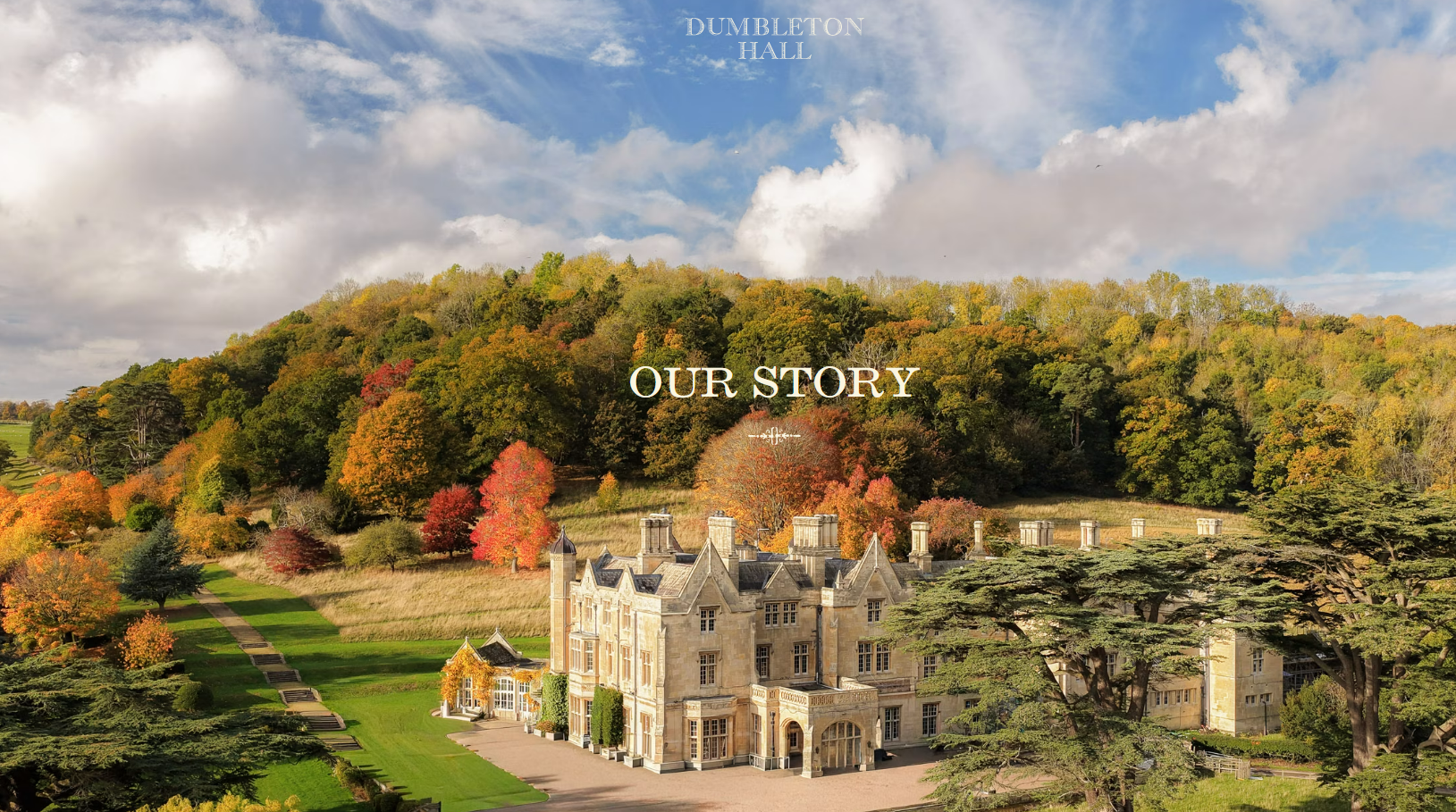
However, Swinton Holland died within a year so the estate passed to his son Edward who set about restoring the estate. Edward Holland commissioned the architect G S Repton to build the new Dumbleton Hall in 1830. The Hall is built of stone, from the Temple Guiting quarries, and of brick. Edward Holland carried out many improvements to the village. He rebuilt some of the farms and constructed a number of semi-detached cottages. In order to carry out all this building work he established a brickyard to the north of the village.
Edward Holland died in 1876 and the estate was sold to Henry William Eyres. Eventually Caroline Eyres inherited the estate and, when she married Bolton Meredith Monsell, the family changed its name to Eyres-Monsell. Mr Eyres-Monsell, who was the MP for Evesham and First Lord of the Admiralty between 1930-1935, was created the first Viscount Monsell of Evesham. In 1959 his widow sold the Hall to The Post Office Fellowship of Remembrance. Their son, the second Viscount, lived at the Mill House until his death in 1993 (see obituary below).
THE GEM OF THE COTSWOLDS: A MANOR HOUSE REBORN
The Hall reopened in April 2026 and is operated by Bespoke Hotels, after undergoing an extensive multi-million-pound redevelopment and upgrade . The below image is take from their website. Click on this link or the image for more details.
Dumbleton Hall Hotel is now owned by Chatham Park Development, a US-based property developer. The historic Cotswolds property was acquired in 2021 by a newly formed UK company, Dumbleton Hall Hotel Property Company Limited, which is controlled by the firm's president, Paul Vezolles. [1, 2]
Their website describes it as a "home shaped by generations of grand history, Dumbleton Hall’s outstanding architecture is now carefully restored and lovingly safeguarded for posterity. Renewed today, it remains a magnificent place of great character and gracious hospitality, warmth, beauty, and generous welcome".