

Church Index and History
Acknowledgments:
The information here is a collection of materials from the Dumbleton Society that existed in the eary 2000's, new photographs taken by villagers in 2025/26 and some extracts from The Arts Society Church Recording, a Record of the Church Furnishings , St Peters Church, Dumbleton. This latter document is a comprehensive catalogue of the chuch with detailed information of every aspect of the church covering Names, Memorials, Metalwork, Stonework, Woodwork, Textiles, Paintings, Library, Windows annd other MIscellaneous topics. The document is held by the St Peters Church Committee who can be contacted via the link button at the bottom of this page.
Index to pages on this site
Brief History
Architectural History ( the following has been extracted from Notes written by Kenneth Steer and Peter Richards, which are publuished in a leaflet in the Church).
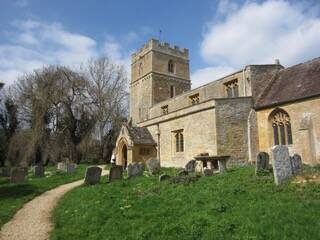
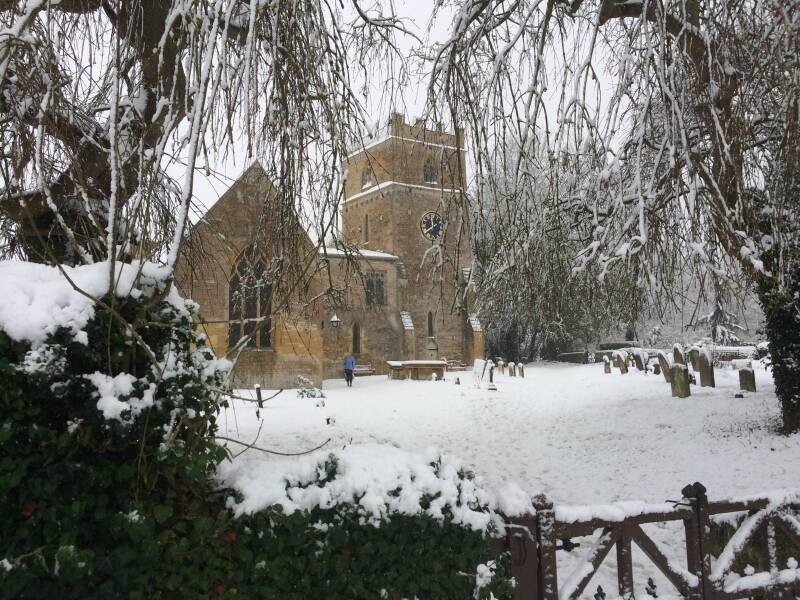
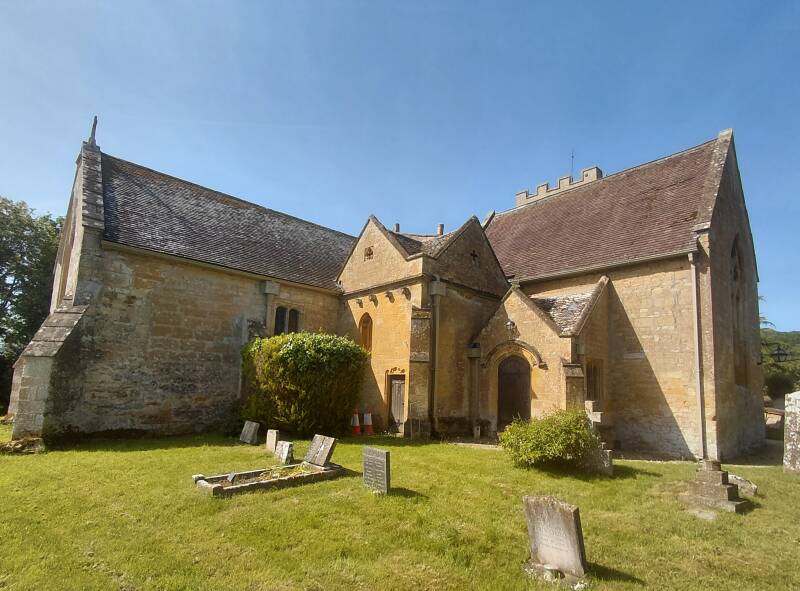
The village of Dumbleton existed at least as early as the 9th century, but although it is likely that a Saxon church stood on the site of the present one no traces of it remain. Possibly it was built of wood, in which case it would be completely demolished when a stone church was erected in the Norman period. The latter consisted simply of a nave and chancel, and was probably built at the charge of Abingdon Abbey who held Dumbleton from the Conquest until the dissolution of the monasteries by Henry VIII. Most of the surviving Norman features are to been seen on the outside of the church. They comprise the north door with its chevroned arch and carved tympanum over a Tudor entrance, parts of the north and south walls of the nave including a number of carved corbels, and a few similar corbels which have been built into the east wall of the 19th century organ chamber. The animal mask on the tympanum, with foliage issuing from its mouth, is a common Romanesque motif, but it has rarely been rendered in such a primitive manner. Inside the church the only Norman remains now visible are a series of decorated stones which have been reused on the underside of the easternmost arch of the south aisle.
The first major alteration to the Norman church was the addition of a tower at the west end in the 13th century. The north-west lancet window in the nave is of similar date, while the outline of the high pitched roof of that period can be seen inside the church on the east wall of the tower.
In the 14th century a disproportionately large transept, its roof higher than that of the nave, was built on the north side of the church by Robert Daston, a member of one of the two principal families in the neighbourhood at that time, as a burial chapel for himself and his family. The northern half of the transept has now been partitioned off to serve as a vestry, and the memorial brass of the founder and his wife, which was still in place in the 18th century, has since disappeared. However, both the north and west windows survive, the former being a particularly fine example of the Decorated style. The chancel arch and the south-west window of the nave are also of 14th century date. Another drastic change took place in the 15th century, when the south aisle was built and the nave walls heightened to include a clerestory. This work involved dismantling the south door of the Norman church, and some of the stones seem to have been reused in the present south door, whose crude construction echoes that of the two clumsy arches of the arcade. The low-pitched roof is characteristic of the late 15th century. The existing aisle windows are of recent origin, but the outline of the original east window, now blocked up, can be seen on the outside of the aisle wall. It is possible that the aisle was built simply to accommodate a larger congregation, but more probably it was intended to provide for a side altar in the period after the Black Death, when great stress was laid on masses for the dead. Also in the 15th century new windows were inserted in the chancel. and the tower was
heightened and equipped with battlements. Presumably the existence of the Daston chapel precluded the erection of a north aisle, although in the absence of such an aisle it is most unusual that clerestory windows should have been provided on the north wall of the nave. In medieval times the nave and chancel were separated by a screen, with a communicating door in the centre. The screen normally consisted of painted panels up to about 4 feet high, with open arcading above, and surmounting it was the rood, or crucifix, with supporting figures of St. Mary and St. John. Along the top of the screen was the 'rood loft', a singing gallery which sometimes contained a small altar used, for some obscure reason, on Maundy Thursday. All that
The first major alteration to the Norman church was the addition of a tower at the west end in the 13th century. The north-west lancet window in the nave is of similar date, while the outline of the high pitched roof of that period can be seen inside the church on the east wall of the tower. In the 14th century a disproportionately large transept, its roof higher than that of the nave, was built on the north side of the church by Robert Daston, a member of one of the two principal families in the neighbourhood at that time, as a burial chapel for himself and his family. The northern half of the transept has now been partitioned off to serve as a vestry, and the memorial brass of the founder and his wife, which was still in place in the 18th century, has since disappeared. However, both the north and west windows survive, the former being a particularly fine example of the Decorated style. The chancel arch and the south-west window of the nave are also of 14th century date. Another drastic change took place in the 15th century, when the south aisle was built and the nave walls heightened to include a clerestory. This work involved dismantling the south door of the Norman church, and some of the stones seem to have been reused in the present south door, whose crude construction echoes that of the two clumsy arches of the arcade. The low-pitched roof is characteristic of the late 15th century. The existing aisle windows are of recent origin, but the outline of the original east window, now blocked up, can be seen on the outside of the aisle wall. It is possible that the aisle was built simply to accommodate a larger congregation, but more probably it was intended to provide for a side altar in the period after the Black Death, when great stress was laid on masses for the dead. Also in the 15th century new windows were inserted in the chancel. and the tower was heightened and equipped with battlements. Presumably the existence of the Daston chapel precluded the erection of a north aisle, although in the absence of such an aisle it is most unusual that clerestory windows should have been provided on the north wall of the nave. In medieval times the nave and chancel were separated by a screen, with a communicating door in the centre. The screen normally consisted of painted panels up to about 4 feet high, with open arcading above, and surmounting it was the rood, or crucifix, with supporting figures of St. Mary and St. John. Along the top of the screen was the 'rood loft', a singing gallery which sometimes contained a small altar used, for some obscure reason, on Maundy Thursday. All that survives at Dumbleton of these elaborate arrangements is the doorway which gave access to the stairs leading up to the loft: it is at the east end of the aisle immediately behind the pulpit. The later structural developments can be briefly summarised. An inscription on the gable-end commemorates a substantial reconstruction of the chancel in 1862, when the east window was replaced (the masonry of the former window was set up as a 'romantic ruin' beside the lake in the grounds of Dumbleton Hall), a new roof was installed and the present tile floor laid. The organ chamber, which houses one of the finest organs in Gloucestershire, was erected at the same 1905

Memorial (see Interior page)
The earliest surviving memorial is the painted stone monument of Sir Charles Percy, his wife and daughter in the chancel. Sir Charles, a son of the Earl of Northumberland, was a prominent figure at the court of Elizabeth I, and in 1603 he took news of the Queen's death to James I in Edinburgh. He became lord of the manor of Dumbleton through his marriage to Dorothy, widow of the late squire, Edmund Hutchins, and died in 1628.
The estate, which comprised the whole of the parish of Dumbleton, passed after her death to her brother, Charles Cocks, who is commemorated by a memorial in Classical
style, with a bust, on the north wall of the chancel. As other memorials show, the estate remained in the possession of the Cocks family until the latter half of the 18th century, while in the 19th century it was acquired by the Hollands.
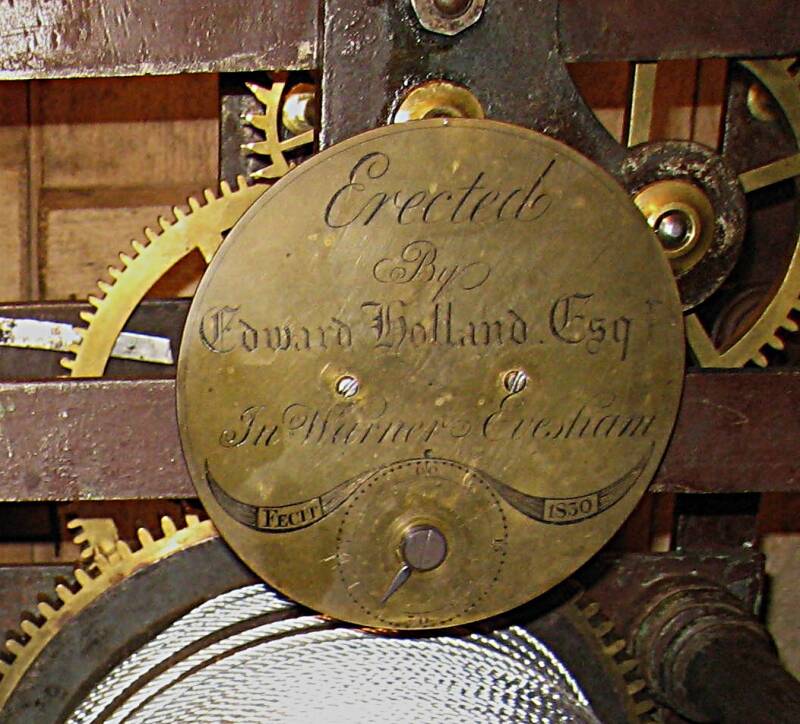
The Elizabethan Hall, which stood in the present park not far from the church (where its site is still visible) was demolished in the 18th century, and in 1830 the present Hall, designed by G. S. Repton, was built for Edward Holland, who is commemorated by the fountain outside the churchyard gate. He was a founder of the Royal Agricultural College at Cirencester, and was a cousin of the Mrs. Gaskell, the novelist.
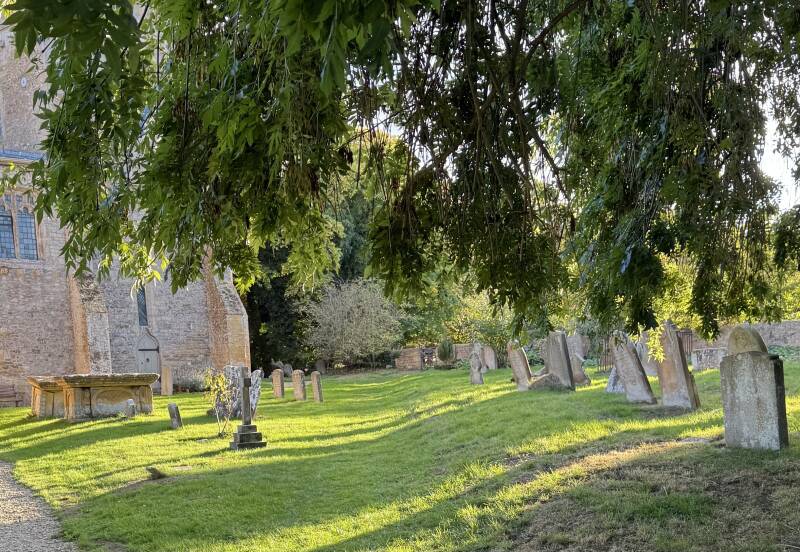
The Hoptonwood stone tablet to a former rector of Dumbleton, Collins Ashwin, is by the renowned master of lettering, Eric Gill. In the churchyard are two Jacobean table-tombs, and three well preserved examples of excellent low-relief headstones compositions of the Resurrection.
Church Bells
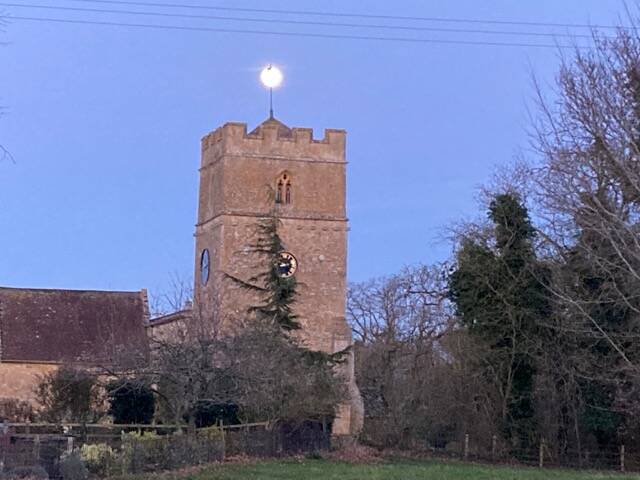
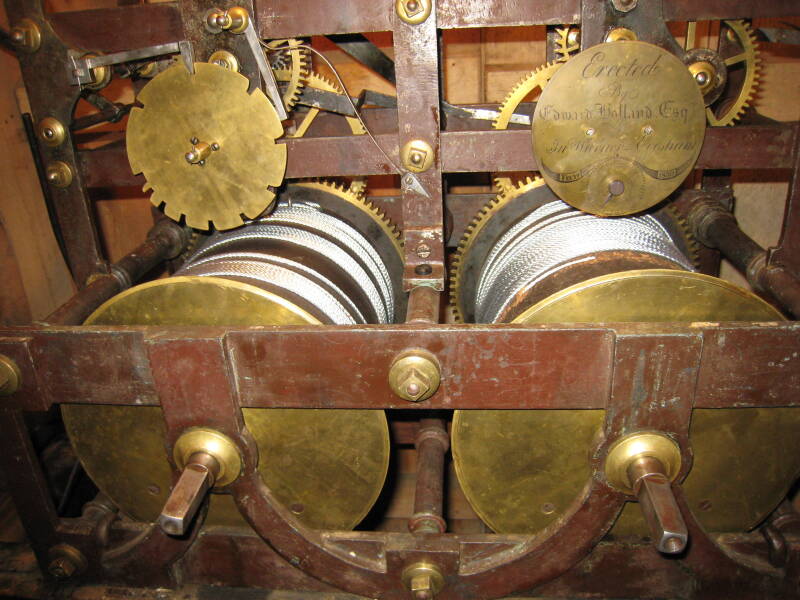
There are six bells in the tower with inscriptions dated 1729, and the clock was installed in 1830*. The font dates from 1661. The oak pulpit and seating introduced in 1905 incorporates attractively carved panelling in the Arts and Craft style. The earliest surviving memorial commemorates the Percy family (17th century), Sir Charles being a prominent figure in the court of Elizabeth I. The most recent is for Gino Watkins an arctic explorer killed in a kayak accident in Greenland. Churchyard monuments include two Jacobean table tombs, and more recently the grave of Sir Patrick Leigh-Fermor.
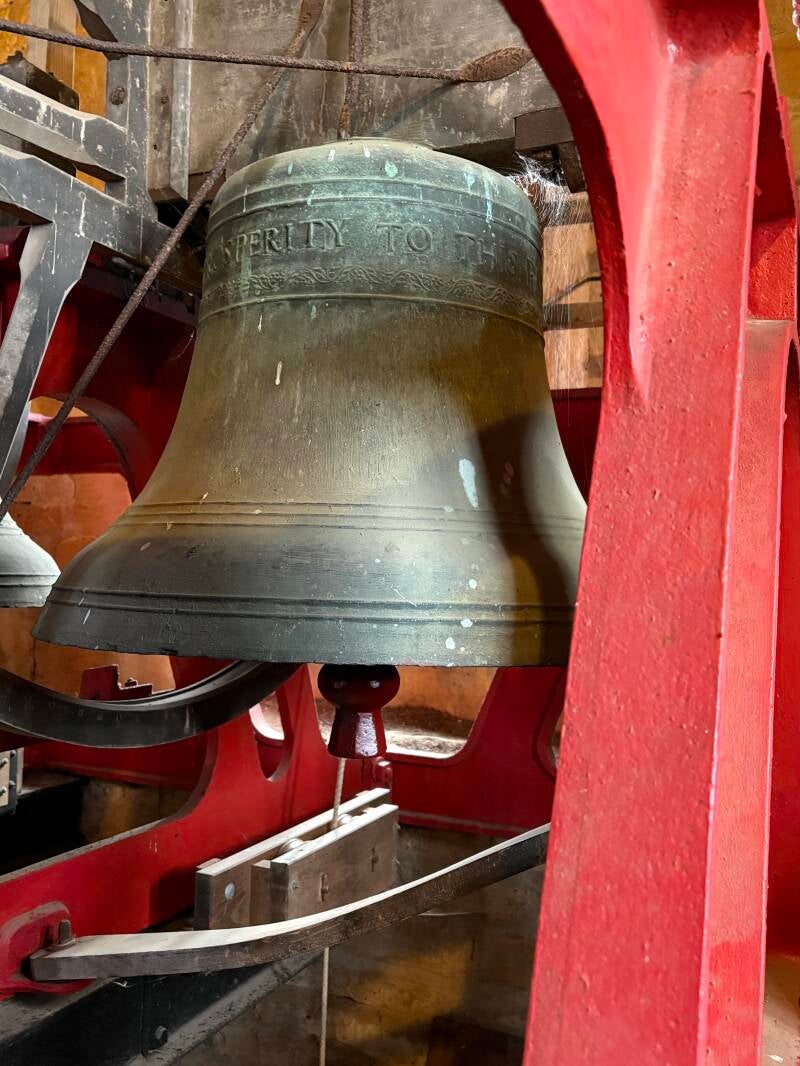
The ring of six bells was cast by Abraham Rudhall in 1729. The iron and steel frame was made in about 1892 by John Taylor and Company. It was the first of its type.
The turret clock mechanism was restored in 2016 with generous donations from parishioners and friends.
The Six Bell inscriptions -
1. Peace and good neighbourhood 1729
2. Prosperity to this Parish 1729
3. Prosperity to the Church of England 1729
4. A B R Rudhall cast us all 1729
5. Rich'd Tyso and John Andrews Churchwardens 1729
6. I to the church the living call and to the grave do summon all 1729

New Heating 2025
In 2025 the heating system in our church was converted from oil to one based solely on electricity. This conversion was rendered necessary by a damaged oil storage tank and an aging oil boiler. It was an opportunity to convert to a net zero carbon system using green energy, and the work fell within the scope of the Church of England's Net Zero Carbon 2030 project.