

Cocks Family
A brief history of the Cocks family
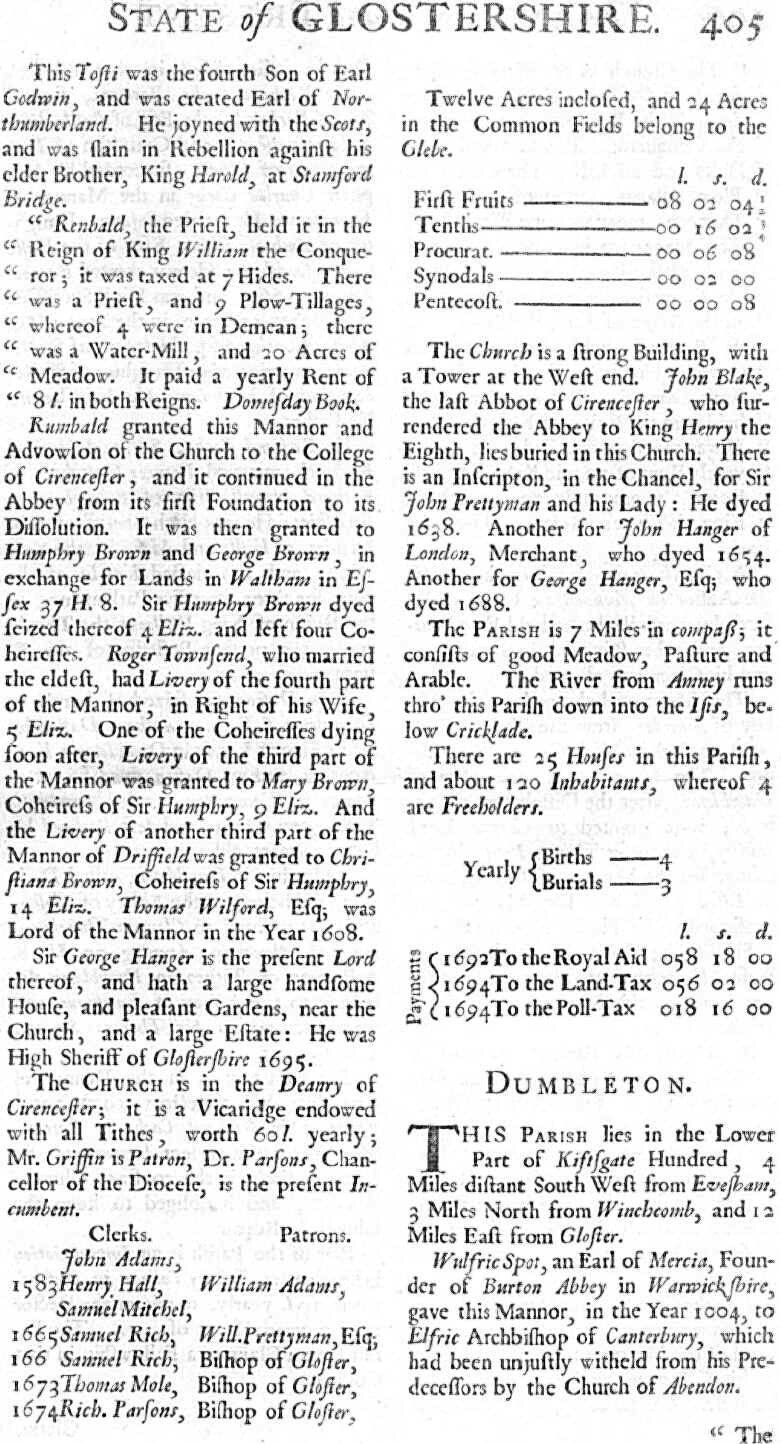
The manor of Dumbleton belonged to the Abbey of Abingdon from the Norman Conquest until the Reformation. Subsequently, after several changes of ownership, it passed to the Cocks family who are commemorated by a number of memorials in the church. The earliest is that of Dorothy Cocks (d. 1646) and her second husband Sir Charles Percy (d. 1628), a son of the Earl of Northumberland.
During the Civil War the Cocks family were Royalists and, after the Restoration, Dorothy's nephew Richard (1602 - 1684), who had succeeded to the estate, was knighted for his support of the King.
The manor house shown in the Kips engraving was probably built by another Sir Richard, grandson of the first, who was Lord of the Manor from 1684 until 1726, and also High Sheriff of Gloucestershire in 1692. As Patron of the Living he was responsible for keeping Dumbleton Church in good repair and had the right to appoint the incumbent. One of his relations was in fact the Rector. (see description of Dumbleton below).
This Sir Richard was succeeded by his nephew Sir Robert Cocks who, "having survived a cruel distemper which carried off his wife and three of his children in the space of a few days", was killed by a fall from his horse in 1765. After his death the estate passed to another branch of the Cocks family living at Eastnor in Herefordshire, one member of which was created Earl Somers in 1821. In 1822 Earl Somers put the Dumbleton Estate up for sale in order, it is said, to help pay for the building of the present Eastnor Castle.
A description of Dumbleton in the time of Sir Richard (1684-1726)
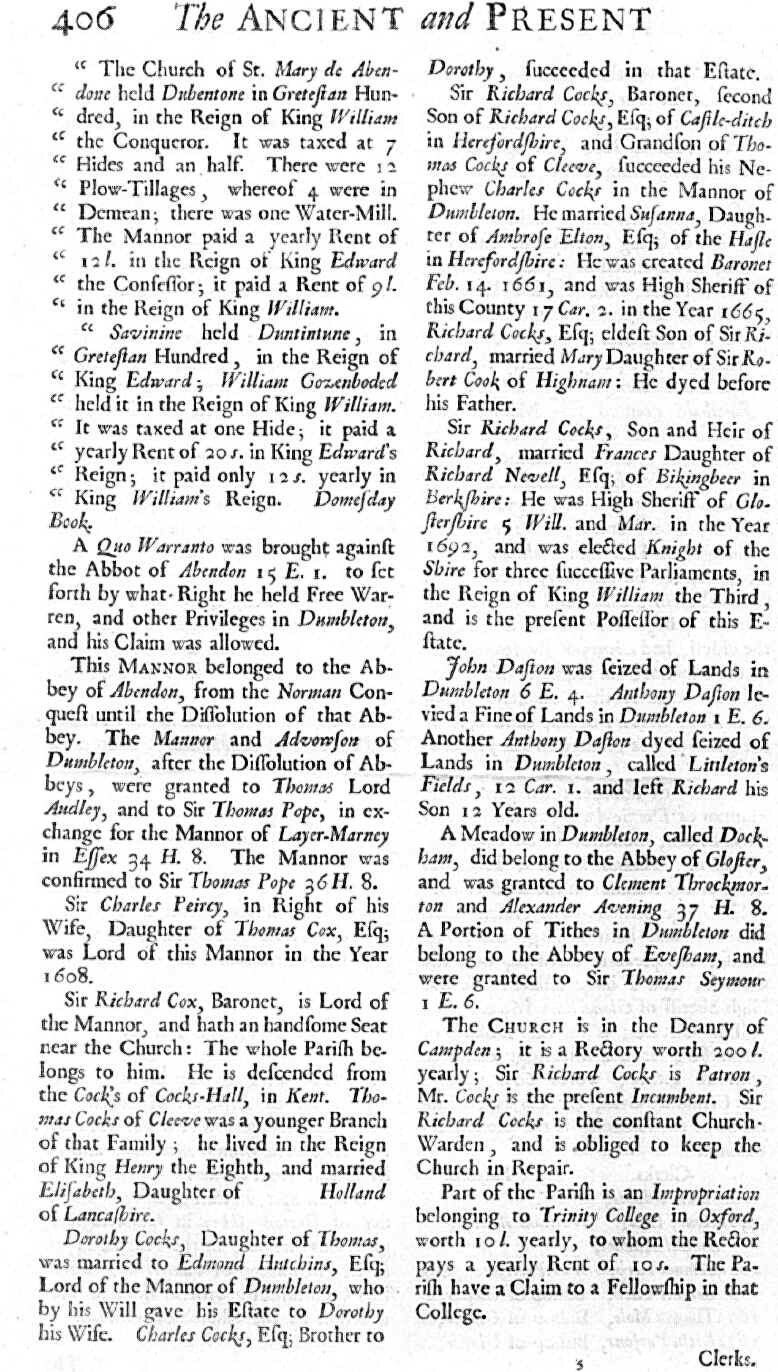
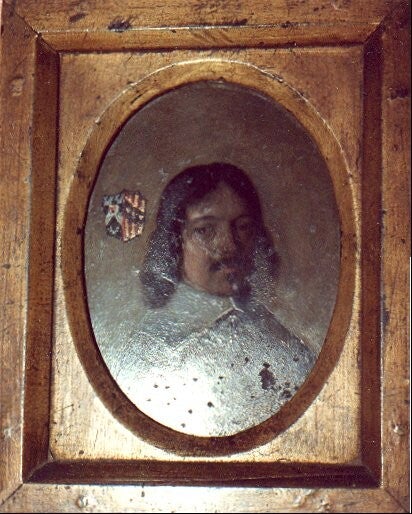
Memorial to Dorothy Cocks (d. 1646) and her second husband Sir Charles Percy (d. 1628)

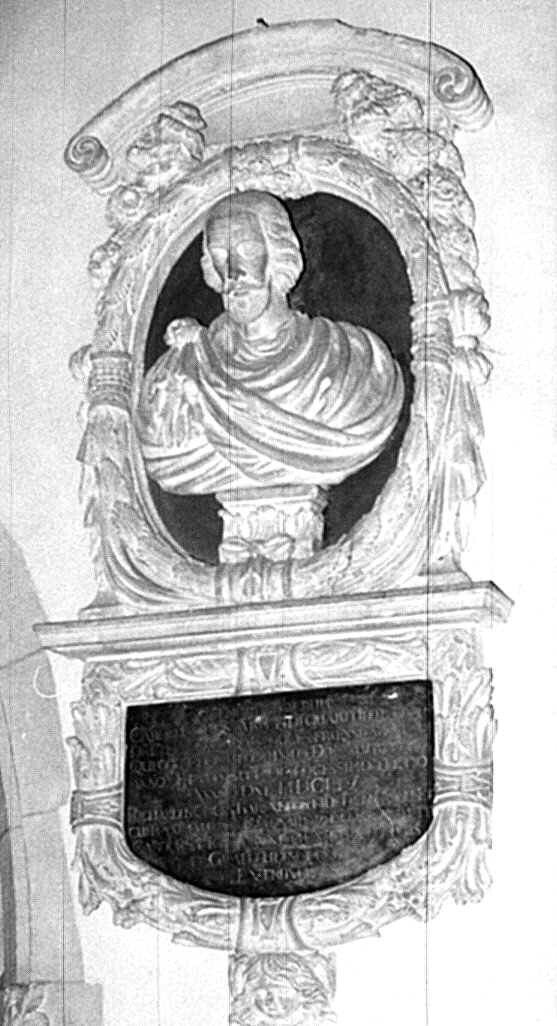
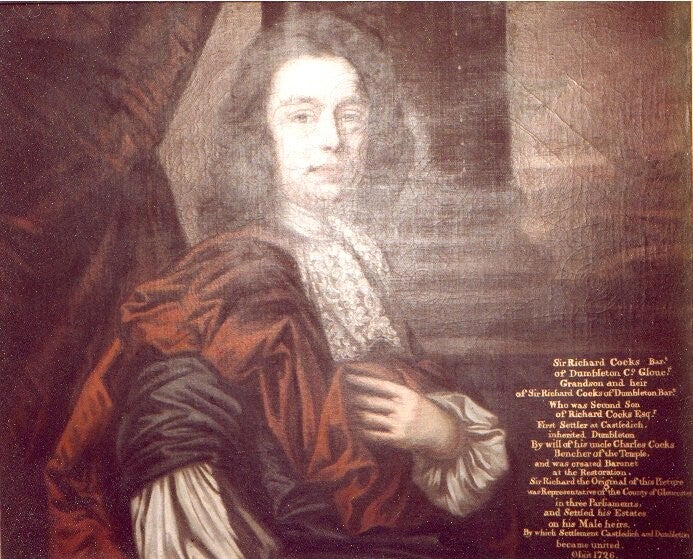
Portrait of the first Sir Richard Cocks. The original portrait hangs in Eastnor Castle
(photograph by permission of The Hon Mrs Hervey-Bathurst)
Portrait of the second Sir Richard Cocks. The original portrait hangs in Eastnor Castle
(photograph by permission of The Hon Mrs Hervey-Bathurst)
Dorothy Cocks – new light on a key person in the history of Dumbleton
This short article introduces some new material based on a recent examination of the wills of Dorothy Cocks and others
Dorothy Cocks was born in Bishops Cleeve, the daughter of Thomas Cocks whose ancient family home one can still see opposite the Apple Tree pub in Woodmancote. In 1591, she married Edmond Hutchins, nephew of Thomas Pope (Pope having acquired Dumbleton after the Abbey of Abingdon, which owned it previously, was suppressed by Henry VIII). Thus began the Cocks family connection with the village that lasted well over 200 years.
Hutchins died in 1602. Though he called himself “Edmond Hutchins of Dombleton” it seems clear from his will that he did not have a house in the village but probably lived at Chipping Norton.
Dorothy inherited the estate. She soon remarried, this time to Sir Charles Percy, third son of the Earl of Northumberland. Sir Charles had been a follower of the Earl of Essex and an associate of his in the Essex Rebellion of 1600. But he was pardoned and remained a prominent figure at the court of Elizabeth I. In 1603, he took news of the queen’s death to the future James I of England in Edinburgh.
Sir Charles and Lady Percy had one child, Anne, who predeceased them. Sir Charles died in 1628; Dorothy in 1646, 55 years after her marriage to the previous owner of Dumbleton. They kneel and face each other, with Anne between them, in a charming if simple tomb in the chancel of Dumbleton church.
We had always assumed that the Percys lived in the village but until we saw her will, there was no proof of this. Her will, which was proven on 28 January 1648 (at the height of the Civil War), can be downloaded from the Public Records Office web site. She asks that her body be buried in the Church at Dumbleton, with that of her daughter (but oddly there is no reference to being buried with the body of her late husband). The will also refers to the arrangements that are to be made for the “Manor House of Dumbleton” and the servants who lived there and looked after her. It is clear from the will that she lived in this house in the village. Since there was no manor house in Hutchins’s time, it is reasonable to assume that the Percys built their own new home somewhere in Dumbleton. For 18 years Dorothy lived alone there.
But where was the house? The will gives itself no clue. There would seem to be two possibilities. Either the manor house was built to the west of the church, on the site where – in about 1695 – Sir Richard Cocks built his new home (see the Kip drawing). Or it was where the Old Rectory now stands: if so the southern, half-timbered part of the present house (as well as the cellar under the northern section) is the remains of the Percys’ manor house. If the first explanation is correct, Sir Richard wholly demolished the old family home to build his mansion; if the second explanation is right, than he partially rebuilt the family home as a rectory for his younger brother.
To complicate matters further, Edmond Hutchins left money to Trinity College Oxford (founded by his uncle, Thomas Pope) requiring that they appoint a resident rector in the village. In understanding where the manor house was one also has to explain where the rector lived. The terrier (land records) of 1666 and 1668 make not mention of rectory though the 1668 terrier does say that ‘Ye Parson’ had a house, garden, orchard and 52 acres of land.
So there is work to do yet on the history of Dumbleton during the time of Dorothy Cocks’s association with the village, and especially to answer the key question: where did Sir Charles and Dorothy Percy (nee Cocks) live? But we know now that she and her second husband made the village their home, employed a wide range of servants here and helped to transform Dumbleton into the fine estate village that it became under her great nephew, Sir Richard Cocks.
Adrian Phillips (with help from Dr Caroline Barron who deciphered the wills)